
Insurance Denied or Underpaid Your Kansas Hail Damage Claim? Here Are Your Real Options
If you live in Wichita, Derby, Andover, Mulvane, Maize, Park City, or anywhere else in Sedgwick County, you filed an insurance claim after the September 3, 2025 hailstorm — and the response from your carrier was not what you expected. The settlement check was thousands of dollars short of the contractor estimates. Or the claim was denied outright. Or the carrier paid the roof but excluded the dented gutters, the broken skylights, the damaged HVAC condenser fins, the cracked window frames, or the siding. Or the claim is in dispute and your adjuster has not returned a call in six weeks. Or your policy turned out to have a wind and hail exclusion that you did not know was there when you signed it.
You are not alone. The Kansas Department of Insurance March 2026 report shows the state paid out $879 million in storm claims in 2025, with Sedgwick County alone accounting for $382 million. That number sounds large until you do the math on it: with 100,000 to 140,000 damaged Wichita-area homes per home improvement industry estimates on KWCH, the average per-home claim payout works out to between $2,729 and $3,820. That number does not pay to reroof a single-family Wichita home in 2026. The full reroof cost on a typical mid-century Sedgwick County ranch home runs $12,000 to $25,000 depending on size, pitch, and material. The gap between what insurance paid and what repairs actually cost is the central financial problem of post-storm Wichita.
This post covers the formal dispute path through the Kansas Department of Insurance, the strategic option of selling rather than fighting the claim, and how a cash sale to Denwich Property Solutions resolves the situation for the seller who has run out of patience or money.
Get Your Free Cash Offer Now!
Fill out this form to get your no-obligation all cash offer started!
Get Your Free Offer TODAY!
Fill In This Form To Get Your No-Obligation All Cash Offer Started!
What "Denied or Underpaid" Actually Looks Like in Sedgwick County
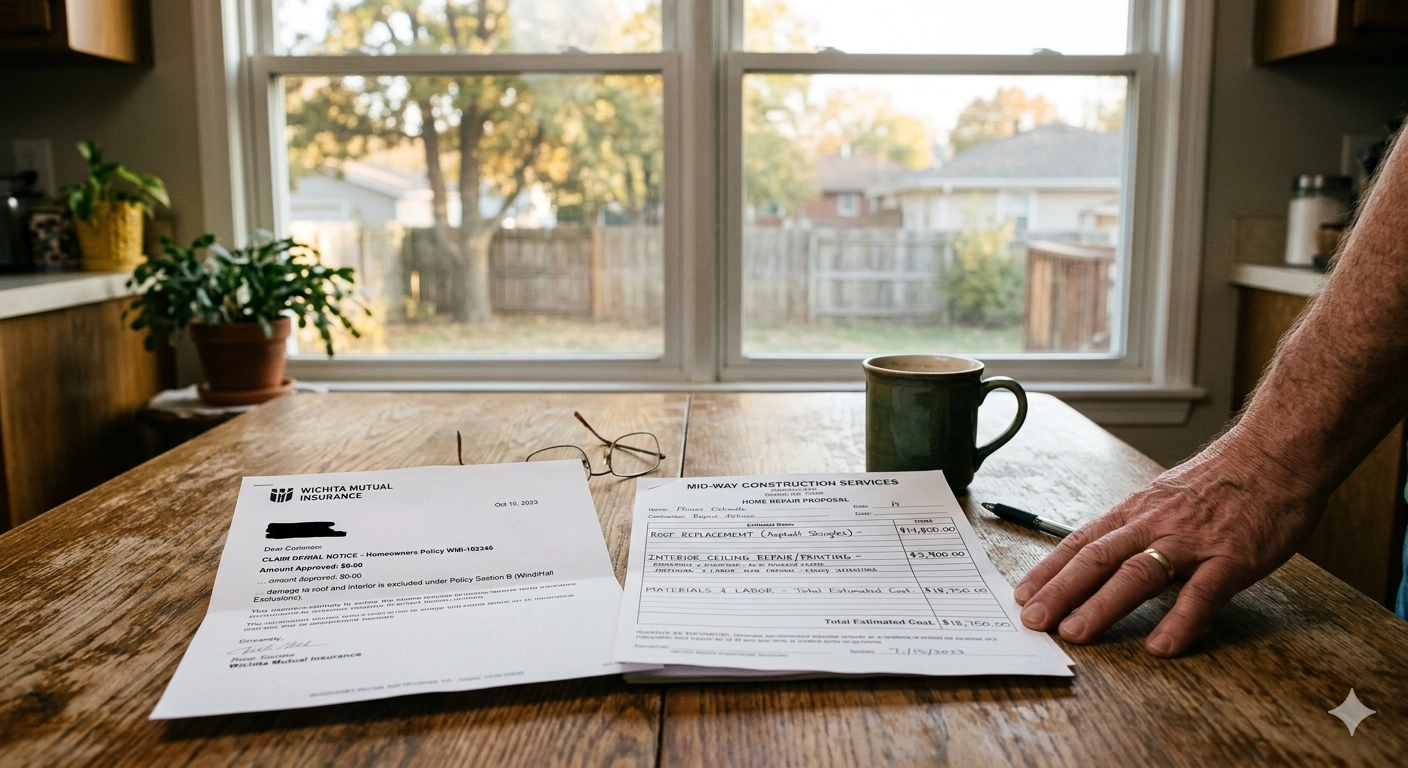
The most common 2025 Wichita-area dispute scenarios that have surfaced in conversations with sellers, attorneys, and public adjusters since the September storm:
Cosmetic damage exclusions on siding and gutters.
Many Kansas homeowners policies issued or renewed after 2022 added cosmetic damage exclusions specifically on metal roofs and vinyl/aluminum siding. The carrier pays for functional damage but excludes anything they label cosmetic, even if the dents are visible from the street, even if the property's resale value is materially affected. The exclusion is buried in the declarations page and most homeowners do not know it exists until they file the claim.
Actual cash value (ACV) settlements on older roofs.
Many policies issued in Kansas after 2018 quietly converted from replacement cost value (RCV) to actual cash value on roofs over a certain age — typically 10 or 15 years. A roof that costs $18,000 to replace at RCV may settle at $6,000 to $9,000 at ACV with depreciation applied, leaving the homeowner to cover the difference.
Pre-existing damage rulings.
The carrier's adjuster identifies a portion of the damage as pre-existing — meaning damage from prior storms that should have been claimed at the time. Some of this is correct; some is the adjuster trying to limit the payout. Disputing it requires comparable evidence (aerial imagery, prior claim records, contractor inspection reports) that the homeowner may not have.
Wind and hail exclusion outright.
Some Kansas policies — particularly higher-deductible policies sold to homeowners trying to lower their monthly premium — have outright wind and hail exclusions. These policies cover fire, theft, and liability but exclude the exact perils that produced the September 2025 damage.
Adjuster delay and non-response.
With 82,498 storm claims filed statewide in 2025 and Sedgwick County the epicenter, adjusters were demonstrably overloaded. Claim turnaround times that should have been 30 days ran 90, 120, sometimes 180. Some homeowners are still waiting for a final inspection in May 2026.
The Formal Dispute Path — Kansas Department of Insurance
Before considering a sale, every Kansas homeowner with a contested claim should know about the formal dispute mechanism. The Kansas Department of Insurance Consumer Assistance Division handles formal complaints against insurance carriers operating in Kansas. The process is free for the consumer. The Department investigates and can require the carrier to respond with documentation, justification, and in some cases revised settlement offers. Commissioner Vicki Schmidt's office has publicly emphasized the consumer-protection role of the department after the 2025 storm season.
The dispute path works best when the homeowner has documentation: original adjuster's report, contractor estimates from at least two licensed Kansas contractors, photos of the damage, copies of the policy declarations and exclusion language, and a written log of communications with the carrier. A public adjuster (a licensed third party who works on the homeowner's side, paid as a percentage of the settlement increase) can also help in larger or more complex cases. Public adjusters operating in Kansas must be licensed through the Kansas Department of Insurance Producer Licensing division.
The realistic timeline for a formal dispute is typically 60 to 180 days. Some disputes resolve in the homeowner's favor with a revised settlement; some end with the original settlement upheld; some end with the carrier offering a partial increase to close the file. None of them resolve quickly enough to help a homeowner who is paying for a hotel because the house is uninhabitable, or watching the property accumulate water damage under a failing tarp, or carrying a mortgage on a property they cannot afford to repair.
When Selling Becomes the Better Math
There is a specific moment when the formal dispute path stops making sense and the sale path takes over. It usually looks like one or more of the following:
- The dispute timeline is longer than the homeowner can carry the property. Monthly mortgage, insurance, tax, and utilities on a $200K Sedgwick County property are approximately $1,500 to $2,200/month. Six months of carrying cost on a property the homeowner cannot live in or cannot afford to repair is $9,000 to $13,000. If the disputed payout increase is less than that carrying cost differential, the dispute does not pay back.
- The repair gap is too large to bridge personally. If the insurance settlement was $7,000 and the lowest contractor bid is $19,000, even a successful dispute that wins another $4,000 still leaves an $8,000 gap. Some homeowners do not have that cash, cannot borrow it, and are unwilling to put it on credit cards.
- The household income that was supposed to fund repairs is gone. If your job at the former Spirit AeroSystems Wichita facility went through reorganization in the Boeing transition, or if you took a household-income reduction for any other reason, the financial assumptions that supported the original plan to repair and stay are no longer in place.
- The contractor market is impossible. Sedgwick County roofers were booked solid through 2025 and into 2026. Even with money in hand, scheduling reliable work was difficult. Some homeowners would rather sell at-is than spend the next eight months managing a construction project.
- You were planning to sell anyway. If the storm damage hit a property you were already preparing to list or sell privately, the storm did not change the destination, it just made the traditional listing path harder.
How a Cash Sale Resolves a Disputed Claim Situation
Denwich Property Solutions buys Wichita-area properties with active insurance claims, disputed claims, denied claims, and settled-but-unrepaired claims regularly. The transaction structure depends on the specifics of your situation, but the basic patterns are:
Pattern 1: You Want to Keep Pursuing the Claim Independently
In some cases, the seller wants to assign the property to us and continue pursuing the disputed claim separately. The legal mechanics depend on the policy language (some policies prohibit claim assignment after sale; some allow it; some require carrier consent), and we work through a Sedgwick County real estate attorney to structure the transaction correctly. The sale price reflects the property's current as-is condition; the claim proceeds, when they come in, go to whoever the policy assignment specifies.
Pattern 2: You Want to Assign the Claim to Us at Closing
In other cases, the seller wants to be done — they want the property sold, the claim assigned to us, and the file closed entirely. We absorb whatever the claim eventually pays as part of our investment math. The sale price is structured to account for the expected claim recovery in our valuation. This is often the cleanest path for sellers who are exhausted by the dispute process.
Pattern 3: The Claim Is Settled — We Buy the Property As-Is
If the claim is already settled (paid or denied) and the seller simply does not want to manage the repairs, we buy the property at its current as-is condition. The settlement proceeds are the seller's to keep. Our offer reflects what the property is worth in damaged condition, which Michelle Wolfson's construction background lets us price accurately.
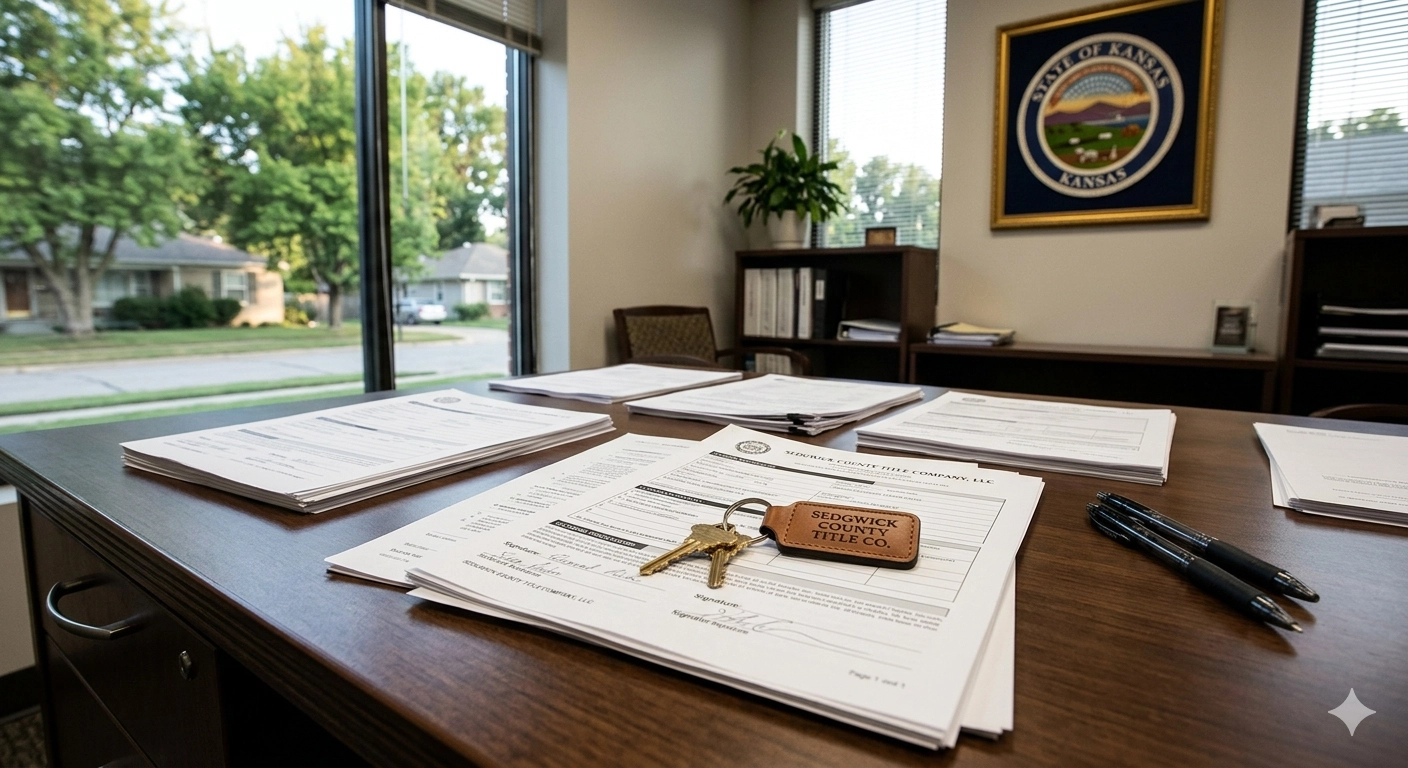
Michelle's Construction Background Matters Here
Most cash buyers operating in Wichita do not have detailed construction knowledge. They use rough rules of thumb to discount storm-damaged properties — generally to the seller's disadvantage, since the buyer's instinct is to over-estimate repair costs to protect margin. Michelle Wolfson holds decades of residential and commercial construction experience, which produces a different conversation. She can walk a property, look at the damage, and tell you within a credible range what the actual repair scope looks like. That accuracy translates to a more accurate offer — typically a better offer for the seller than a guessing buyer would make, because she does not need to over-discount to cover unknown risk.
This is the single most important difference between Denwich and a generic 'we buy houses' operator in the Sedgwick County market for storm-damaged properties. We are not guessing what the repairs cost. We know.
Disclosure Reality Under Kansas Seller Disclosure Law
If you decide to list the property traditionally rather than sell to a cash buyer, you have a disclosure obligation. Kansas law requires sellers to complete the Seller's Disclosure of Property Condition form. Active hail damage, an unrepaired roof, an active or denied insurance claim, and material storm damage to any structural component are conditions that must be disclosed honestly. Failure to disclose creates civil exposure under Kansas common-law fraud principles for years after closing. Some sellers attempt to under-disclose, hoping the inspector will miss the damage. In a post-September 2025 Wichita market, no competent inspector is missing hail damage. The deal collapses at inspection, and the seller has spent two or three months losing the listing window without producing a closed sale.
The cash sale to Denwich avoids the disclosure-driven inspection collapse because we are not inspecting the property to find reasons to walk; we have already absorbed the damage situation in the offer.
Get Your Free Cash Offer Now!
Fill out this form to get your no-obligation all cash offer started!
Get Your Free Offer TODAY!
Fill In This Form To Get Your No-Obligation All Cash Offer Started!

Ready to Talk Through Your Specific Claim Situation?
You do not need to share your policy declarations or your dispute correspondence to start the conversation. You only need to know the property address, roughly what the damage looks like, what stage the insurance claim is at (open, settled, denied, in dispute, never filed), and what your current carrying cost on the property is. We do the rest of the diligence on our end.
Call us. Email us. Fill out the form.
 Kansas: (316) 202-9024 • Nationwide: (567) 694-6873
Denwich Property Solutions • John & Michelle Wolfson • Derby, KS